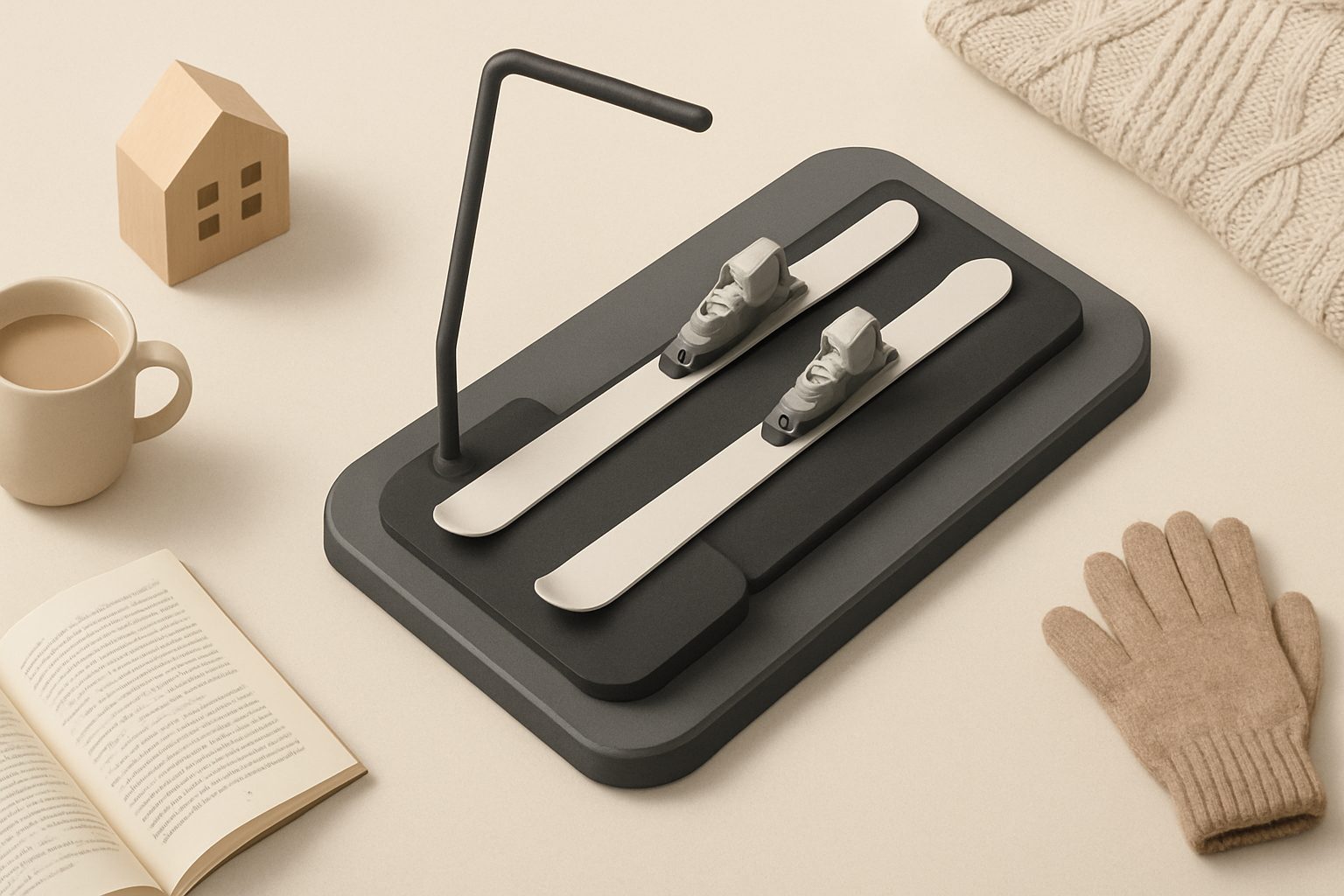
What Is a Home Ski Simulator and How Does It Actually Work?
A home ski simulator is a stationary fitness machine designed to replicate the physical demands of skiing without needing snow, a slope, or a trip to the mountains. It combines several mechanical and sometimes electronic components to recreate the lateral movement, balance challenges, and muscular engagement of downhill skiing. Some versions are compact enough for a spare room; others resemble small gym equipment.
The real appeal isn't novelty—it's that skiing is genuinely difficult to train for at home otherwise. You can't improve your leg strength or cardiovascular fitness on the slopes themselves if you don't live near mountains or can't afford frequent trips. A simulator bridges that gap.
How the Lateral Slide Works
The foundation of most home ski simulators is a sliding deck—typically a smooth, angled platform beneath your feet. Your skis or special boots sit on this deck, which moves side to side along rails or guides, mimicking the lateral (sideways) motion you make during carving turns on real snow.
This sideways movement is what makes a ski simulator feel fundamentally different from a treadmill or rowing machine. In real skiing, your legs and core work to control lateral edge pressure and directional changes. The sliding deck forces your stabiliser muscles to engage in the same way—your inner thighs, outer hips, and core all contract to keep you balanced as the platform glides left and right.
The angle of the deck matters too. Most simulators are tilted at 15–25 degrees, angling downward toward your toes. This mimics the forward lean you'd naturally assume on a ski slope and shifts more weight onto your quads and glutes, which are the primary muscles active during skiing.
Cable Resistance and Hydraulic Systems
To create resistance—the feeling of actually moving through snow—simulators typically use one of two mechanisms: cables or hydraulic cylinders.
In cable-based systems, two cables (one on each side) are attached to the sliding deck. As you push the deck side to side, the cables create tension that resists your movement. The harder and faster you move, the greater the resistance. This is elegant because it's mechanical, requires no electricity, and naturally scales effort—you can ski gently or intensely depending on how much force you apply.
Hydraulic systems use fluid-filled cylinders instead. As the deck slides, it compresses hydraulic fluid, which resists the motion. Hydraulic resistance is often smoother and more adjustable (some models allow you to dial in the resistance level), but these systems are more complex and prone to maintenance issues if seals fail.
A few premium home simulators add electric motors that actively drive the deck for you at varying speeds, though this is less common in home equipment and more typical of commercial gym versions.
Treadmill Belt Integration
Some—though not all—home ski simulators incorporate a motorised treadmill belt running along the length of the sliding deck. This belt moves backward under your feet, simulating the feeling of moving down a slope. Your body stays roughly in place (like on a real treadmill) whilst the belt moves beneath you.
The treadmill belt serves two purposes: it adds a cardiovascular challenge (your heart rate climbs faster) and it more closely replicates the sensation of actual skiing, where you're moving downhill continuously. Without a belt, the simulator is pure lateral resistance training—brilliant for strength but less demanding aerobically.
Simulators with both a treadmill belt and lateral slide are more expensive and take up more space. They're also more forgiving on your knees because the continuous backward motion (like a gentle downslope) is easier on joints than pure isometric lateral work. Without a belt, the static lateral movement can be tough on knees if your form isn't perfect.
Tilt and Incline Adjustment
Most quality simulators allow you to adjust the angle of the deck—increasing the slope simulates steeper terrain. A steeper angle increases the demand on your quads and glutes and makes it harder to control the lateral slide, mimicking the difficulty of skiing a black run versus a blue run.
Some models also adjust the forward lean angle independently of the slope, giving you options to target different muscle groups or adjust difficulty without increasing the actual incline.
What You Actually Feel
When you step onto a home ski simulator for the first time, the experience is somewhere between a balance board and a resistance machine. Your legs immediately work to stabilise yourself. If there's lateral resistance, you feel it the moment you try to move the deck side to side. If there's a treadmill belt, your body leans slightly forward as it pulls beneath you.
It's not identical to skiing—there's no wind, no visual feedback of changing scenery, no fear of actually falling. But the muscular effort and the engagement pattern are remarkably similar. Your heart rate climbs quickly, your legs burn, and your core stays engaged the entire time.
Who Actually Uses Them?
Serious skiers use simulators to maintain fitness and technique during summer months or in years when they can't afford mountain trips. Fitness enthusiasts use them as an alternative to other cardio and strength machines. Physiotherapists sometimes recommend them for lower-body rehabilitation because skiing engages muscles comprehensively whilst remaining low-impact (depending on the model).
Home ski simulators aren't essential fitness equipment, but they're genuinely useful for anyone wanting to build lower-body strength and endurance in a way that transfers directly to skiing performance.
More options
- Lateral Ski Slide Trainers & Ski Simulator Machines (Amazon UK)
- Ski Balance & Rocker Boards (Amazon UK)
- Ski Fitness Slide Boards (Amazon UK)
- Ski Resistance & Plyometric Training Equipment (Amazon UK)
- Protective Floor Mats for Home Gym / Simulator (Amazon UK)